Eiffels
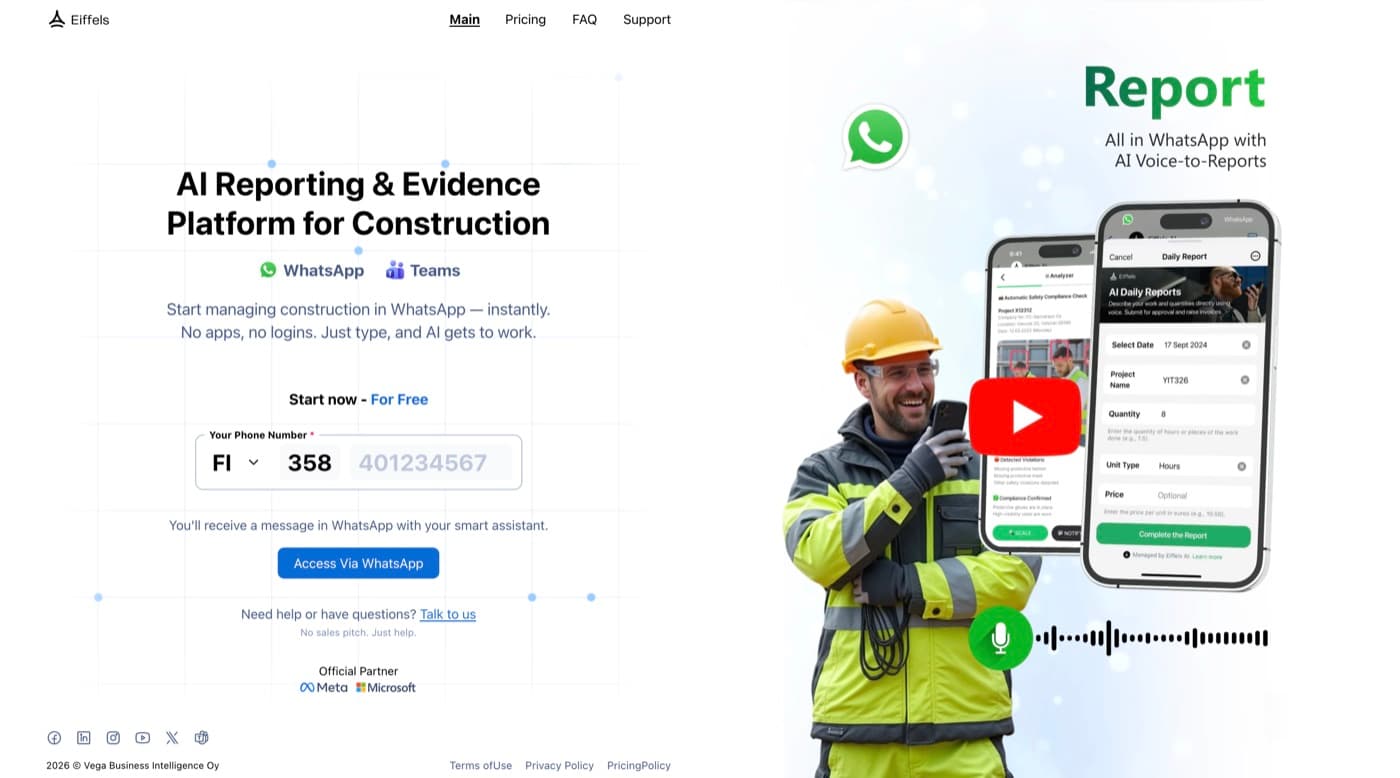
Eiffels turns what teams already send — voice notes, site photos, group chats, field forms — into structured records in CRM, ERP and BI, without anyone retyping them. It lives inside WhatsApp, where the crews already are; I worked on it in its construction context, where forms, reporting, voting and AI translation all happen in chat, backed by a dashboard.
Web + Product design
Visit live projectThis case study is being filled in — process, artefacts and outcomes are added as I write them up.
- Year
- 2024
- Industry
- Construction tech
- Contribution
- Web + Product design
- Status
- Live · in pilots
The product problem
Construction teams already coordinate inside WhatsApp, often across languages and changing field conditions. Eiffels needed to add structured workflows without asking people to abandon the tool they use every day.
Ownership & contribution
I joined a product whose reporting flow had been designed for an office desk, and we reworked it around the site: one hand on a phone, gloves on, standing outdoors. I went out to the sites to see the work in its own conditions and ran ~8 interviews — with the builders filling reports in and the managers reading them afterwards — plus two moderated group usability sessions of four people each. A year and a half on the product, working with the team and with frontend developer Anton Kappi: the public website, the internal SaaS dashboard, the multilingual WhatsApp flows and the design system connecting them.
- Web design
- Product design
- WhatsApp UX flows
- Design system
How the experience took shape.
Conversation
Put workflows inside WhatsApp
Forms, reporting, voting, and AI-powered translation were shaped as conversational flows, keeping field interactions familiar and reducing the jump between tools.
Oversight
Give teams a clear control layer
The dashboard brings reports, statuses, and permissions into a structured view for the people who need to coordinate work beyond an individual chat.
System
Unify three product surfaces
A modular design system creates one visual and interaction language across WhatsApp, the marketing site, and the operational dashboard.
Decisions → interface
How it was worked out
Before the interface there was a map: what the product is, who touches it, what the stack has to carry — and every branch a conversation can take inside WhatsApp.
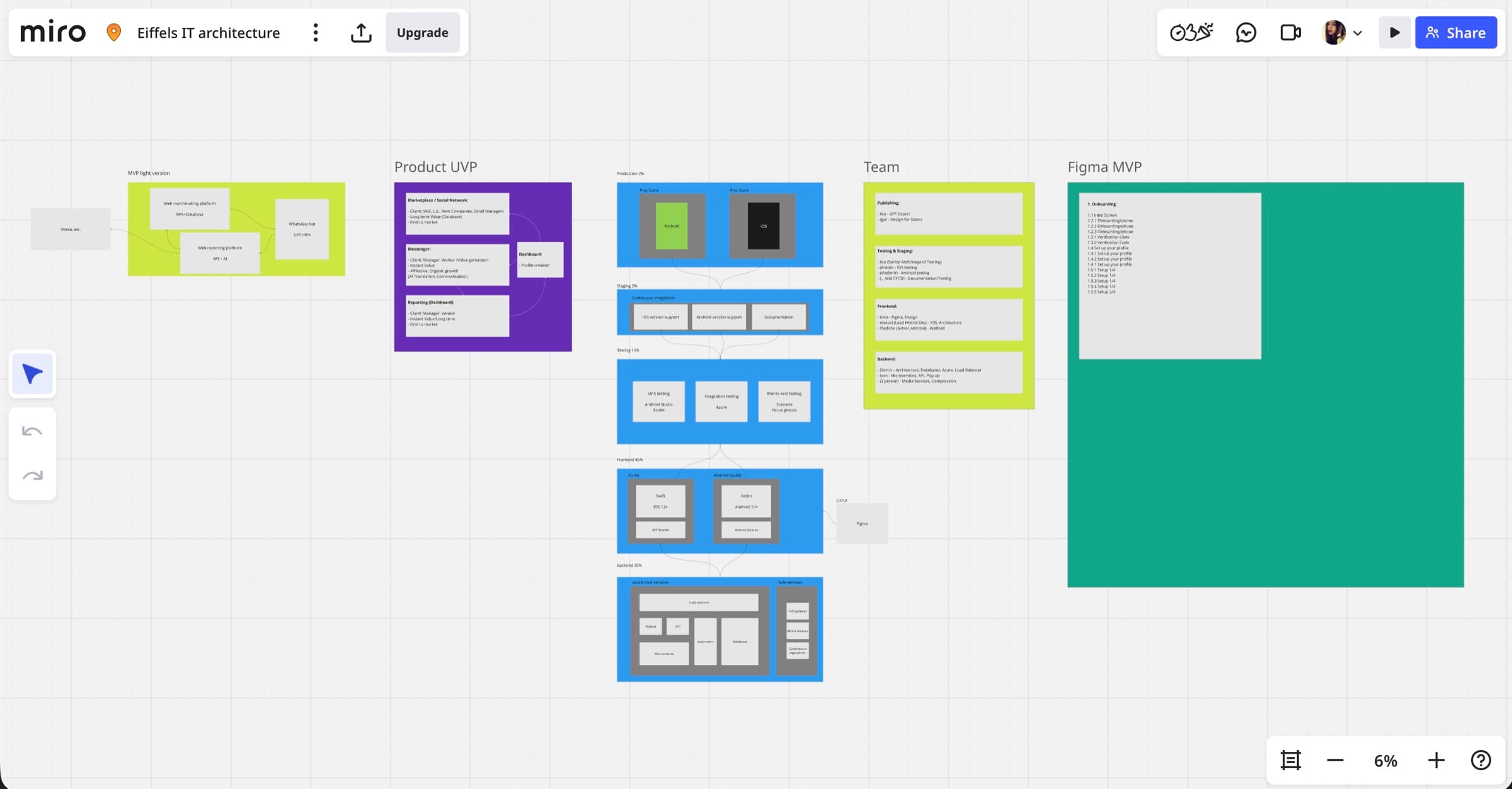
Product & architecture
One board holding the whole product
MVP scope, the value proposition per audience — client, manager, worker, vendor — the release pipeline across iOS, Android and web, the stack, and who on the team owns which part. Design decisions get made against this, not against a screen in isolation.
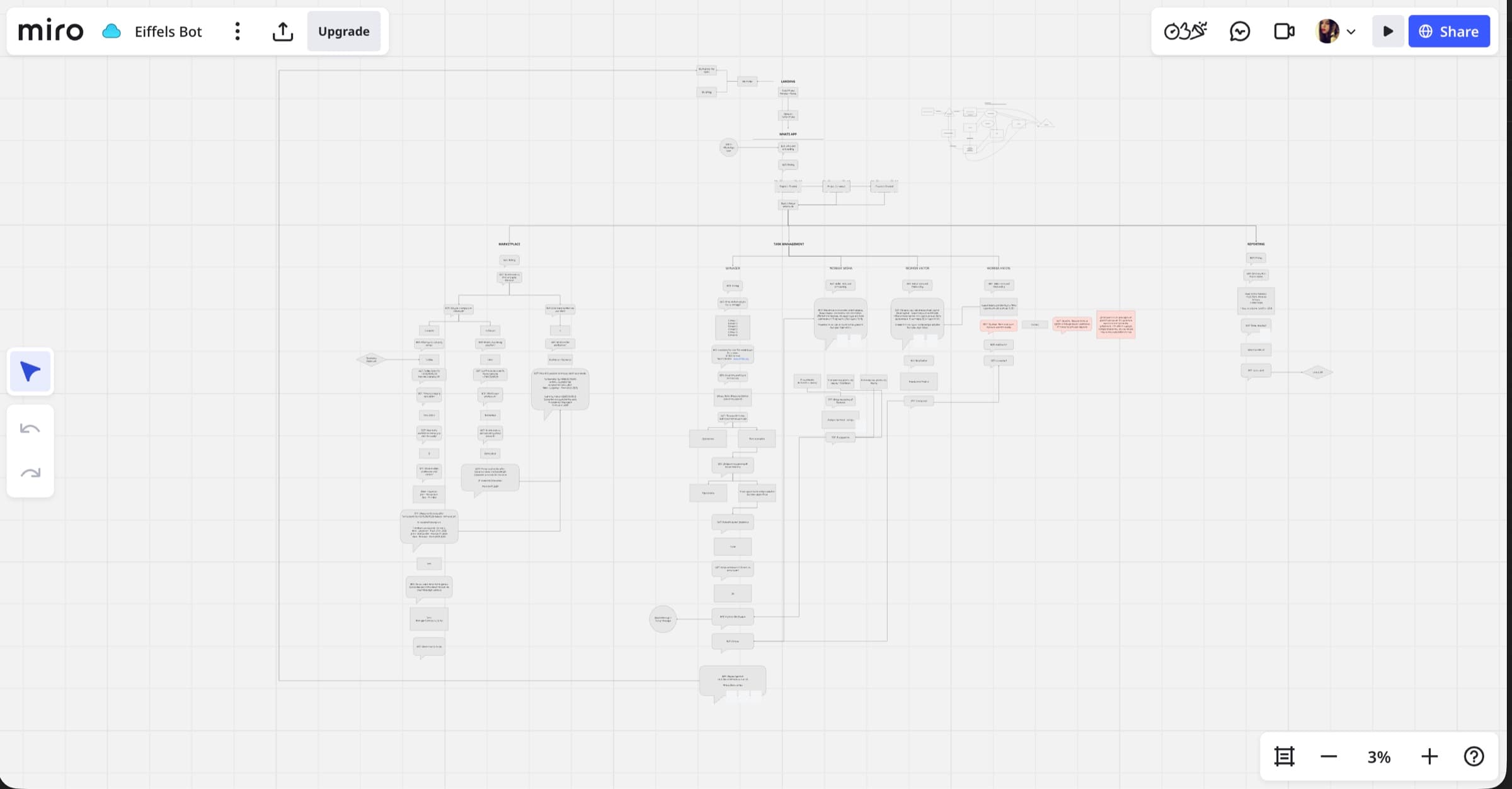
Conversation design
Every branch a message can take
The bot flow mapped end to end: onboarding, marketplace, task management across four roles, and reporting — with the dead ends marked in red. Cutting the report from seven steps to three started here, on this map, not in the UI.
Working boards, not presentation slides — this is where the decisions were argued out.
See it running
Eiffels in use
The reporting flow as a site worker meets it, inside WhatsApp.
Planned tests · not results
What was tested, and how
The A/B test and the usability sessions were run in production; each status below says where the work reached.
Old flow vs guided short path
Do site workers finish a report more often when the path is short and guided?
- Method
- A/B test of the reporting flow in production.
- Success signal
- The guided short path won: the old version left people unsure what was even being asked of them.
Work that moved the product forward.
Designed the marketing site and the internal SaaS dashboard.
Designed the multilingual conversational UX flows inside WhatsApp — forms, reporting, voting, and AI translation.
Worked on the design system unifying WhatsApp, the website, and the dashboard.
Developed in collaboration with Anton Kappi — Frontend Developer (UI Engineering / Web Platform).
- Year
- 2024
- Contribution
- Web + Product design
- Industry
- Construction tech
Live · in pilots