Stobi
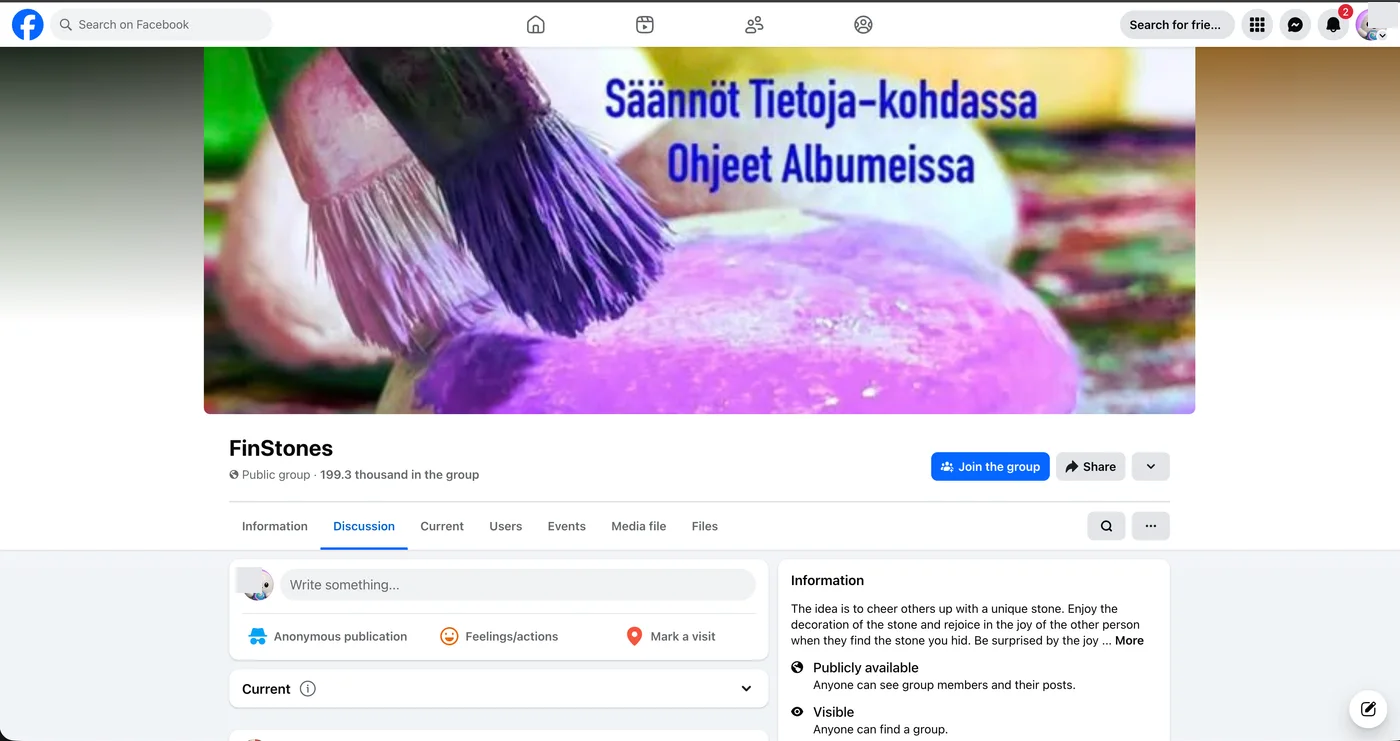
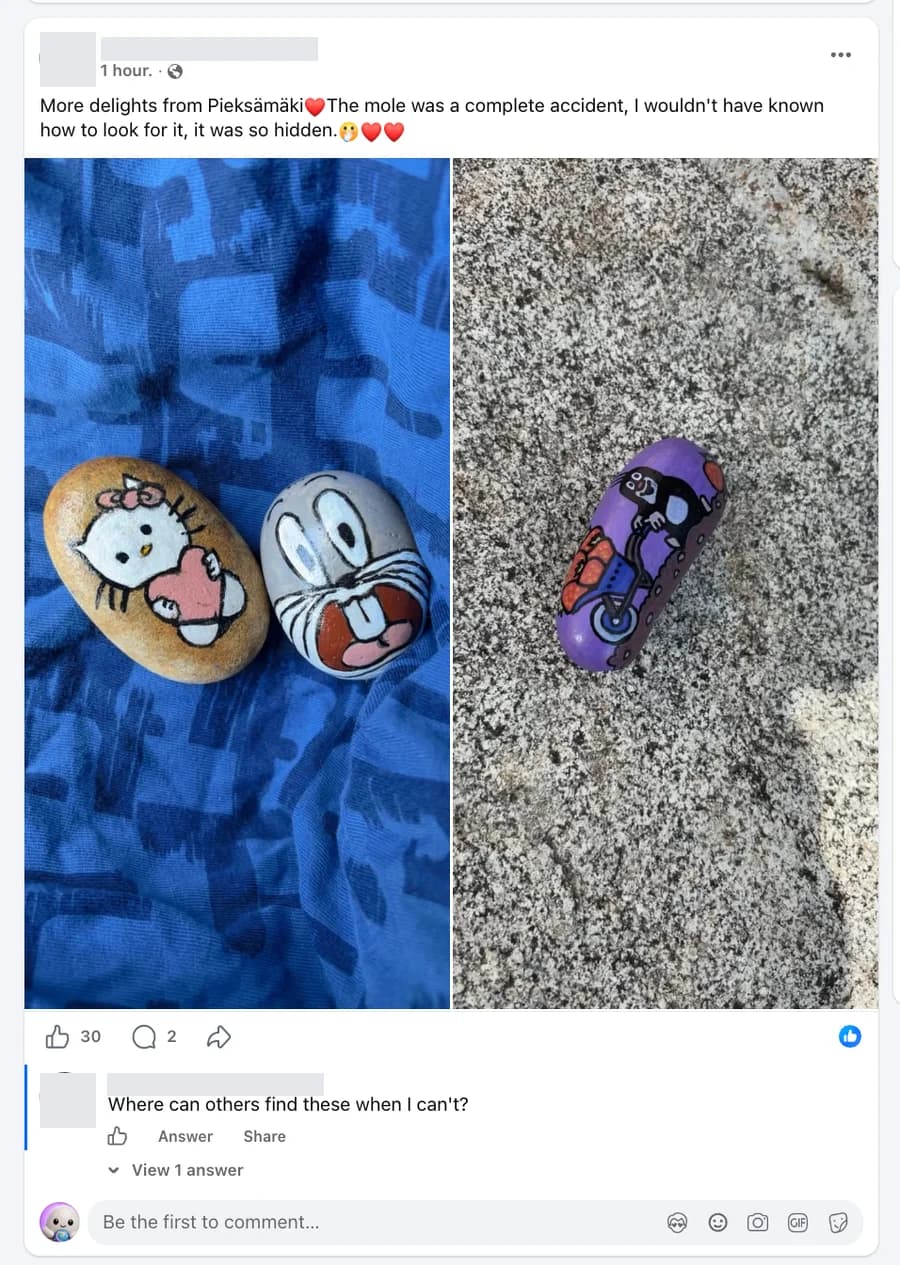
Painted-stone communities currently live in fast-moving Facebook groups where around 1,000 posts can appear in a day. A find becomes one isolated post and is quickly buried: the artist, the person who hid it, the people who found it, and the stone's full history are difficult to recover. Stobi gives every stone a persistent identity and connects each verified find into one visible journey.
Product + UX/UI + Brand + Character + Frontend + Backend
Visit live projectThis case study is being filled in — process, artefacts and outcomes are added as I write them up.
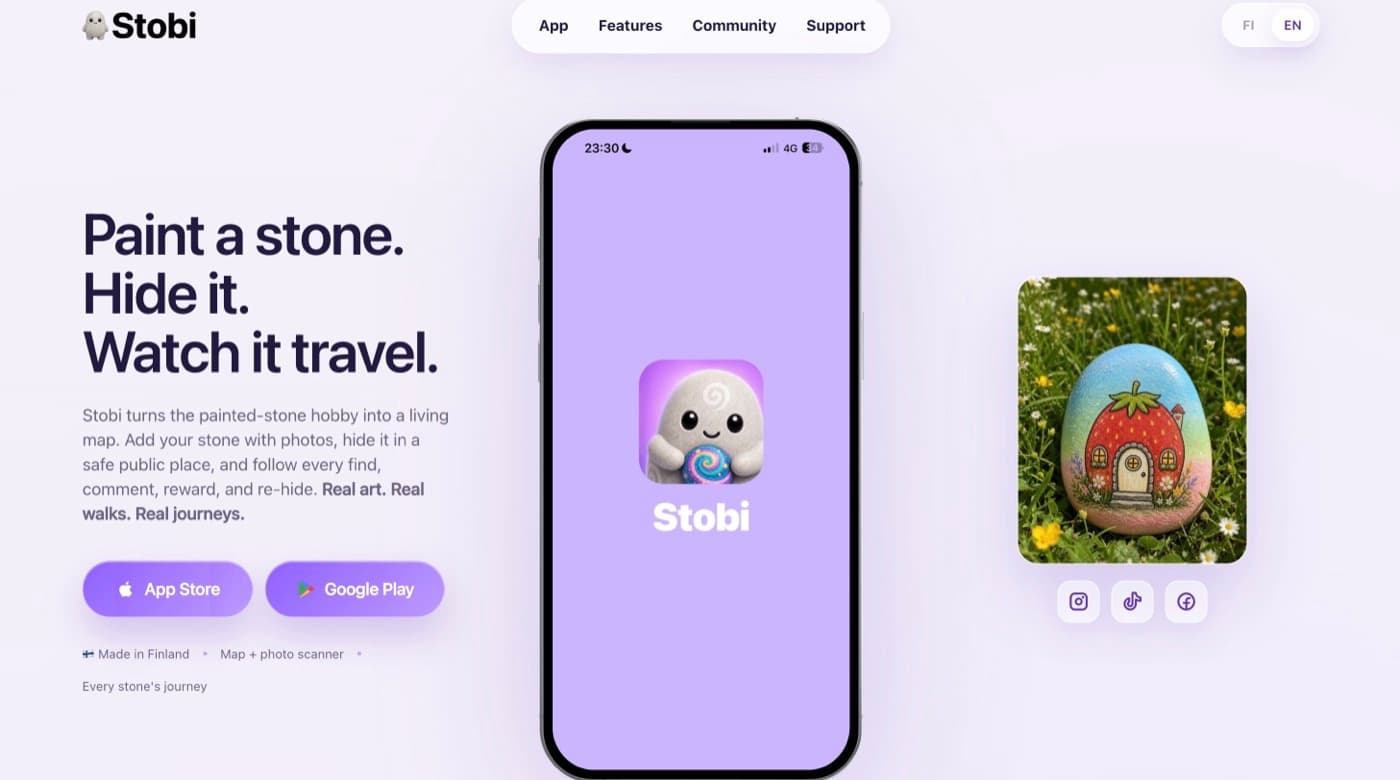
- Year
- 2026
- Industry
- Consumer app
- Contribution
- Product + UX/UI + Brand + Character + Frontend + Backend
- Status
- Website live · iOS & Android apps released
The product problem
Facebook groups are feeds, not a product built around the identity of a stone. With around 1,000 posts appearing in a day, a find is quickly pushed out of view — making it difficult to trace who painted the stone, who hid or found it, and how its journey unfolded over time.
Evidence → insight → decision
From a noisy feed to an object-centered product.
I studied the existing community behavior before defining screens. The key shift was to stop treating each find as a post and start treating the stone as the persistent product object — with people, places, and events connected around it.
- Community observation
- Behavior & role mapping
- Information-loss audit
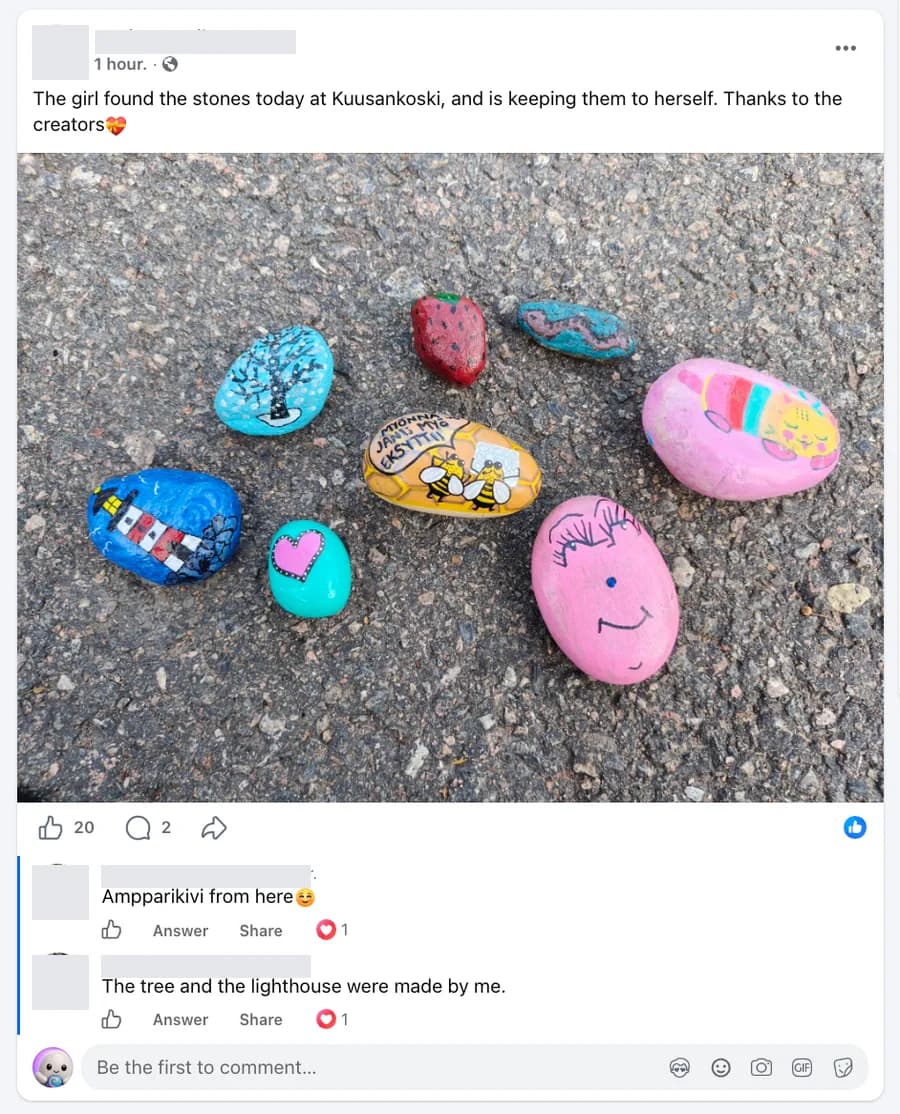
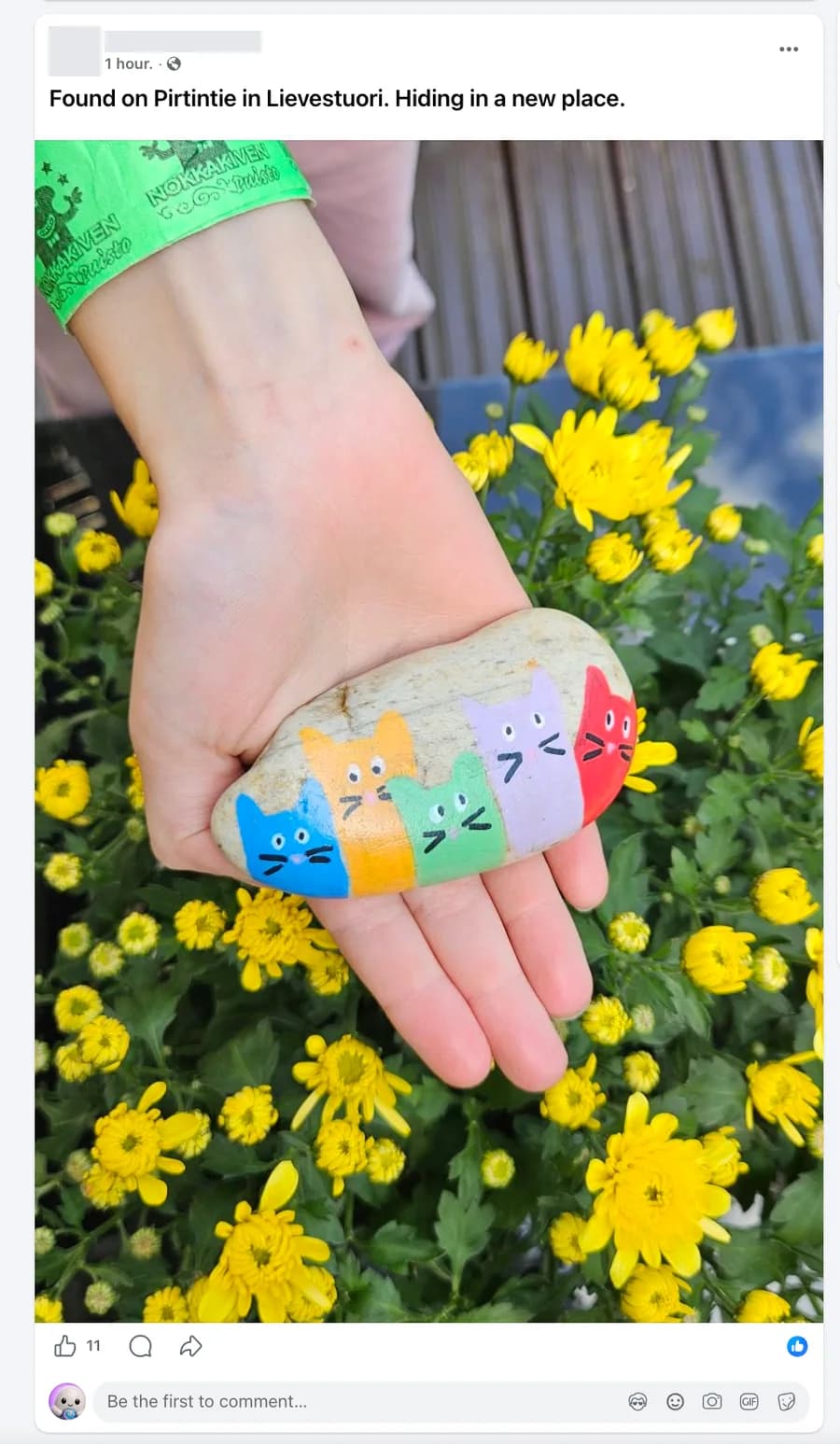
Affinity clusters → strategic reframing → product model
Raw signals
What the community revealed
OBS · 01Around 1,000 posts can appear in one active group in a day.
OBS · 02One find is published as a new, isolated post.
OBS · 03Creators return to comments asking whether their stone was found.
OBS · 04Artist, hider, finder, place, and photos live in different posts.
OBS · 05An artist’s work has no single public home.
OBS · 06A finder may not know whether the stone has appeared before.
Affinity themes
Three patterns emerged
Memory gap
The feed remembers posts, not stones.
As new content arrives, the object’s authorship, status, and history become hard to recover.
Identity gap
Every sighting starts from zero.
Without a persistent identity, similar stones and repeated finds cannot form one trusted record.
Creator gap
Artists are visible once, then disappear.
Their work is scattered through the feed instead of building a recognizable body of work.
Object model
One identity connects the whole journey
One trusted identity
- Artist
Authorship & portfolio
- Find
Photo & finder
- Place
Location & hide
- History
Every re-hide
Scanner + profile + journey history + map
Evidence
Around 1,000 posts can appear in one active Facebook group in a day.
Insight
A feed optimizes for what is new, so older finds and their context quickly become difficult to recover.
Product decision
Give every stone one persistent identity that remains findable beyond the original post.
Evidence
A find is usually published as one isolated post, separated from earlier and later sightings.
Insight
Artist, hider, finder, photo, and location are parts of one story — not separate pieces of content.
Product decision
Model the product around a connected journey with roles, events, and locations attached to the stone.
Evidence
Creators often return to the comments to ask whether anyone has found the stone they hid.
Insight
Facebook provides activity around posts, but no dependable status or notification tied to the physical stone.
Product decision
Notify the creator when their stone is found and keep each find visible in the stone's journey.
Evidence
The groups contain many artists, but their stones are scattered across unrelated posts.
Insight
Without a portfolio connected to authorship, people cannot discover a creator's body of work or recognize their style.
Product decision
Give every artist a public profile that collects the stones they created, hid, and contributed to the community.
Evidence
A person begins with an unknown physical object and may not know whether it has appeared before.
Insight
The system must establish both that a drawing exists and which stone identity the scan belongs to.
Product decision
Use two AI decision gates before a find can update a journey: drawing detection, then identity matching.
Ownership & contribution
Two months from idea to both app stores. As the founder, Product/UX/UI and Brand Designer, character creator, and builder, I translated that fragmented social-feed behavior into a structured product model: stone, artist, scan, match, find, location, and re-hide. I created the brand and Stobi character system, designed the scanner logic, built the frontend and part of the backend, and brought in a backend and AI specialist to refine the system further.
- Idea & market research
- Product & UX
- Brand design
- Character design
- Frontend
- Backend (partial)
Built withReact Native, Next.js, Supabase, AI
Collaboration
- Anton DeminBackend, GPS & AI scanner
Collaborates on backend development, GPS functionality, and the AI scanner implementation.
How the experience took shape.
AI scanner
Recognize a painted stone
The scanner first determines whether the camera is looking at a stone with a drawing. This is the product's entry point — the journey cannot begin from an unrelated object or image.
Identity
Decide: the same stone or another
After recognizing a painted stone, the AI determines whether it matches an existing stone or should be treated as a different one. That decision protects each stone's identity across repeated finds.
Verified journey
Preserve the story Facebook loses
Once the stone is identified, every artist, finder, hider, photo, location, and re-hide stays connected to the correct journey. The history remains discoverable instead of disappearing under newer posts.
One scan, two AI decisions, one trusted journey.
I structured the experience around the decisions the system must make before a find can be trusted. Each branch gives the user a clear next action instead of exposing the AI model or leaving them in an ambiguous state.
- ~1K
- Posts can appear per day in an active group
- 02
- AI decision points
- 01
- Persistent identity per stone
- 01. Scan the stone: The user opens the scanner and frames the painted surface so Stobi can begin validation.
- 02. Is a drawing present?: The first AI decision checks whether the scan actually contains a painted stone.
- 02A. Guide & rescan: Stobi explains what is missing and returns the user to the camera with a clear correction.
- 03. Same stone or different?: The second AI decision compares the scan with known stones before anything is added to a journey.
- 03A. Open existing identity: A match reconnects the find to the artist and every earlier location in the same journey.
- 03B. Create a new identity: A different stone receives its own record, keeping two similar-looking journeys separate.
- 04. Add the find: The user adds a photo and location to the verified stone instead of creating a disconnected upload.
- 05. Continue the journey: The updated stone appears on the map and can be re-hidden for the next person to discover.
Decisions → interface
From first scan to a visible journey.
The screens below are from the current mobile build. I use them here as evidence of how the product model became an interface: the scanner captures a physical object, the record keeps its authorship and history, and the map returns that history to the real world.

Brand & character design
I built a character system, not just a mascot.
I designed the Stobi brand and its central character as part of the product experience. The character gives the app an emotional anchor across discovery, scanning, progress, and chat, while the icon carries the physical-to-digital idea: one companion holding one painted stone with its own identity.
Primary signature
One shape, one name, one recognizable world.
The primary lockup pairs the character silhouette with a direct wordmark. Generous clear space lets the soft 3D texture and bold typography read as one confident signature across store, product, and campaign surfaces.

- Stobi violet
#8F4CFF - Soft lavender
#C7B0FF - Night ink
#17112E - Cloud
#F7F5FC

Character language
Emotion is part of the interface.
I developed a repeatable expression and pose system so Stobi can communicate success, encouragement, uncertainty, surprise, fatigue, and error states without losing its recognizable silhouette.
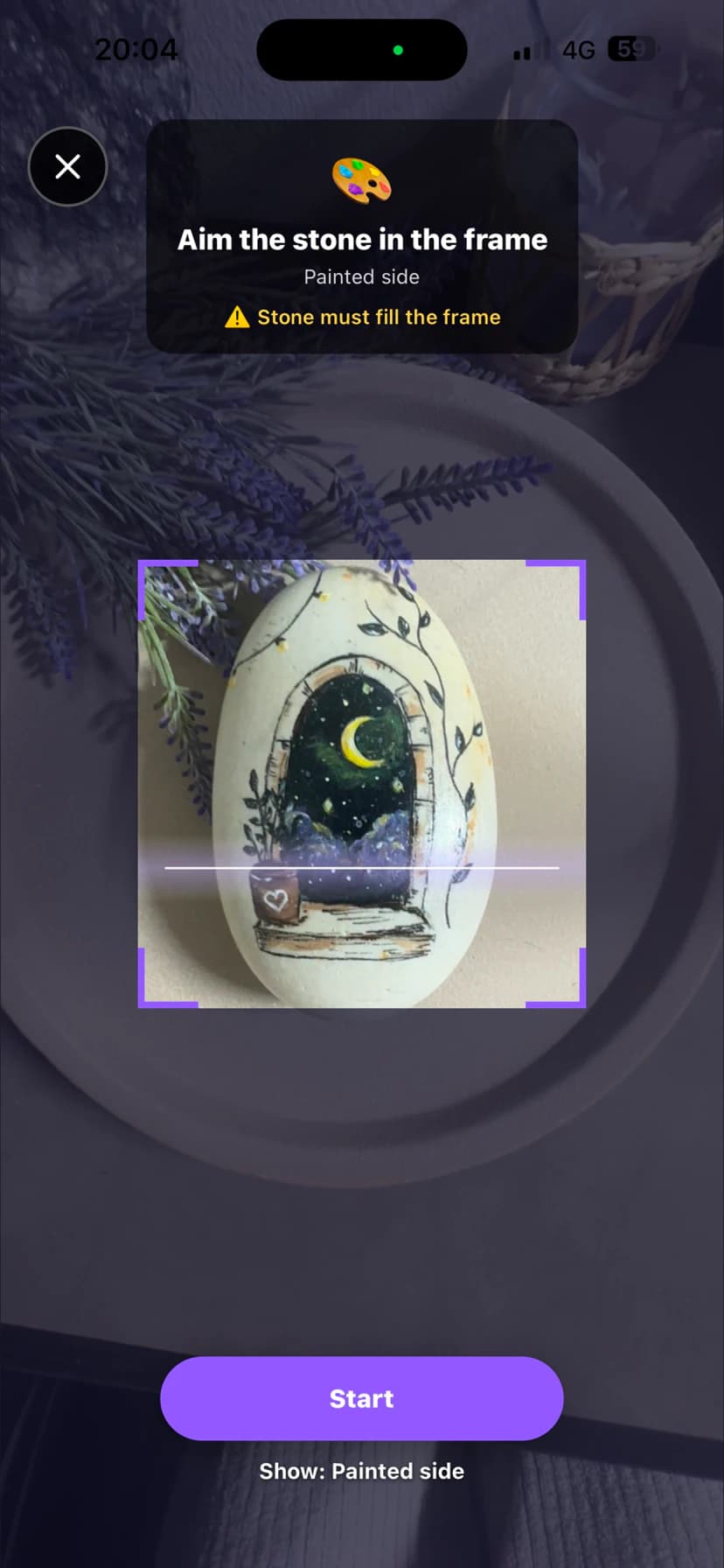
01 · Capture
Frame the painted surface
The scanner makes the capture requirement explicit: show the painted side and let the stone fill the frame. This reduces ambiguity before the AI makes an identity decision.
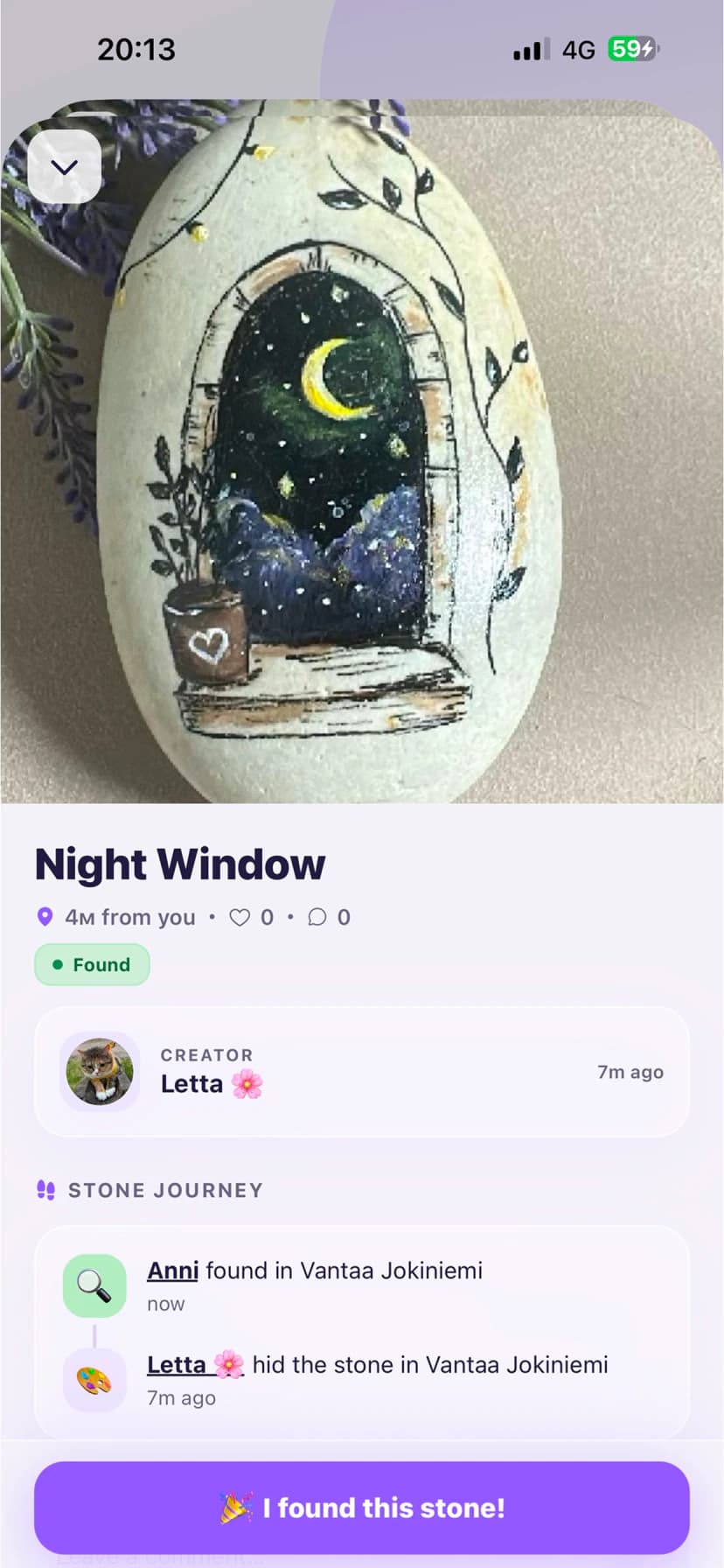
02 · Identity
Open one persistent record
A verified stone record keeps the creator, current status, distance, finds, hides, and chronology together instead of scattering them across unrelated posts.
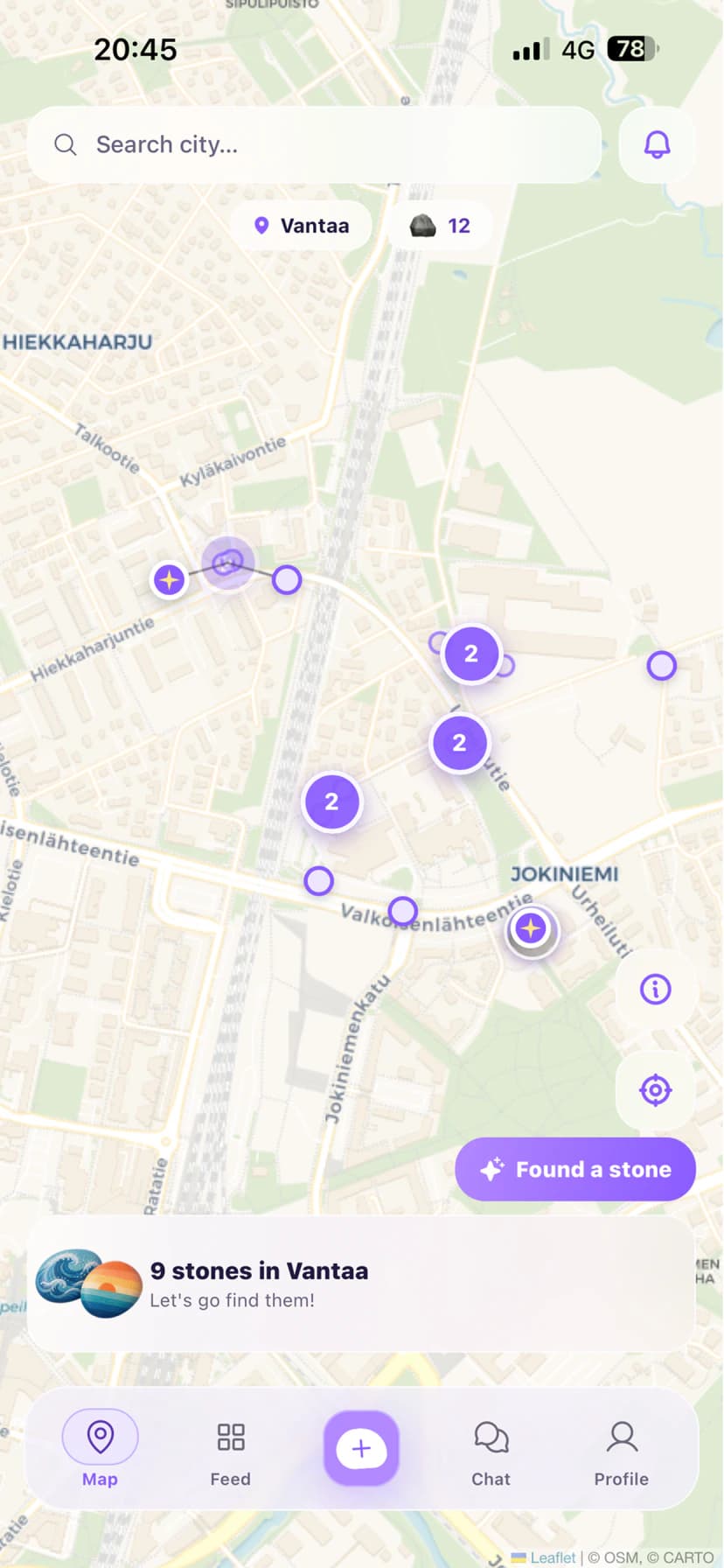
03 · Continue
Return the story to the map
The map turns isolated sightings into an explorable network of nearby stones and gives the finder a clear way to continue the journey in the physical world.
Current product build · real screens, not usability-test evidence
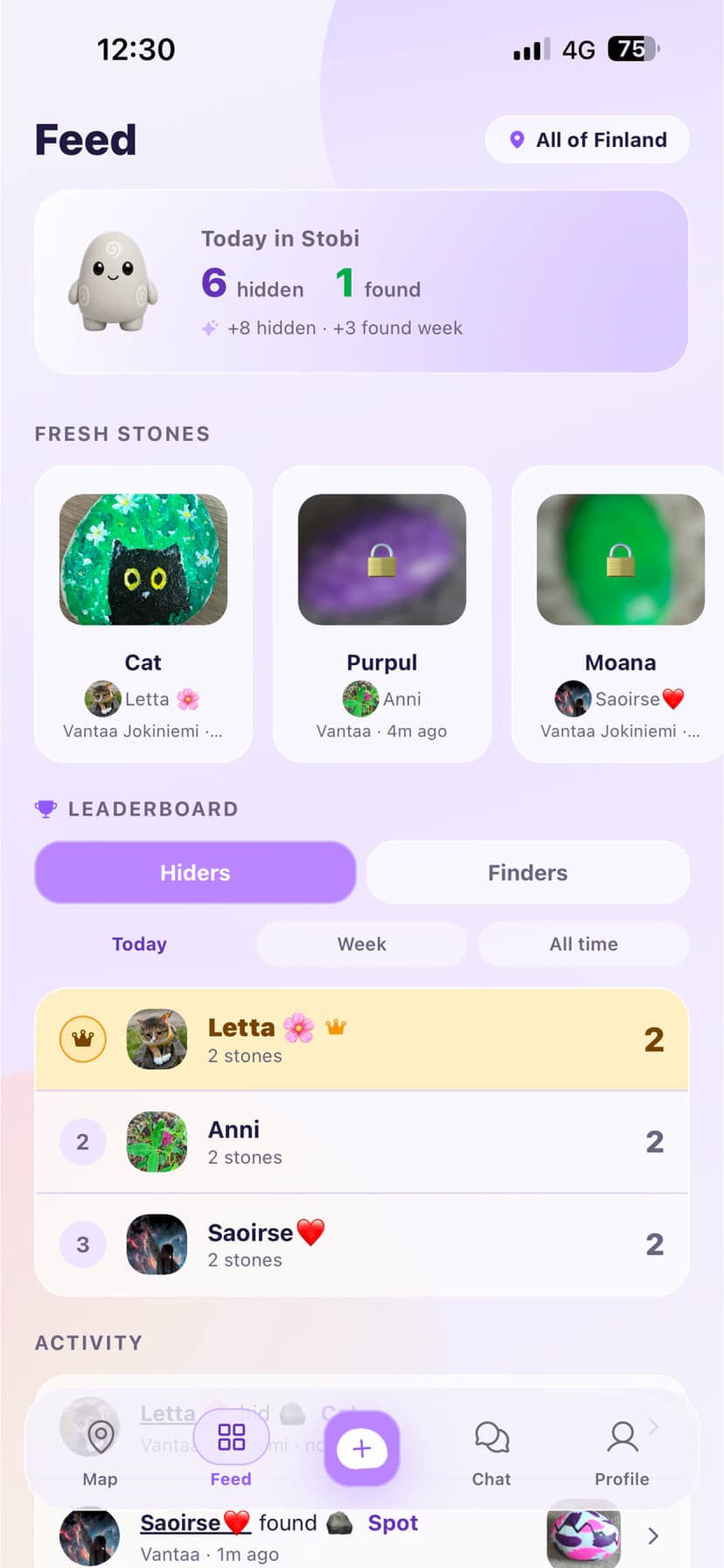
Community
Feed & activity
Fresh stones, local activity, and leaderboards preserve discovery without making the feed the source of truth.
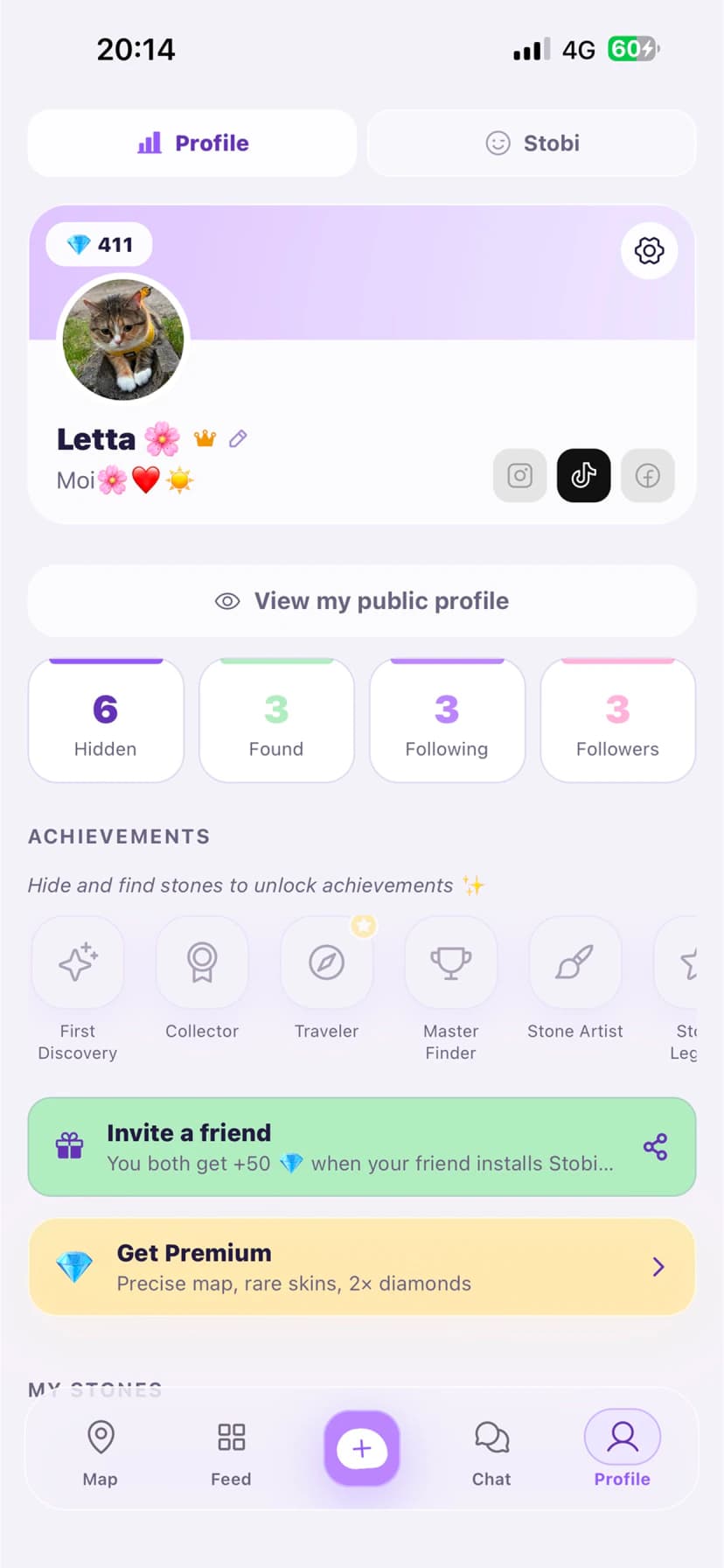
Artist identity
One profile for the creator and their work
Created, hidden, and found stones live under one public identity, so authorship stays visible and people can recognize an artist's body of work instead of searching through unrelated Facebook posts.
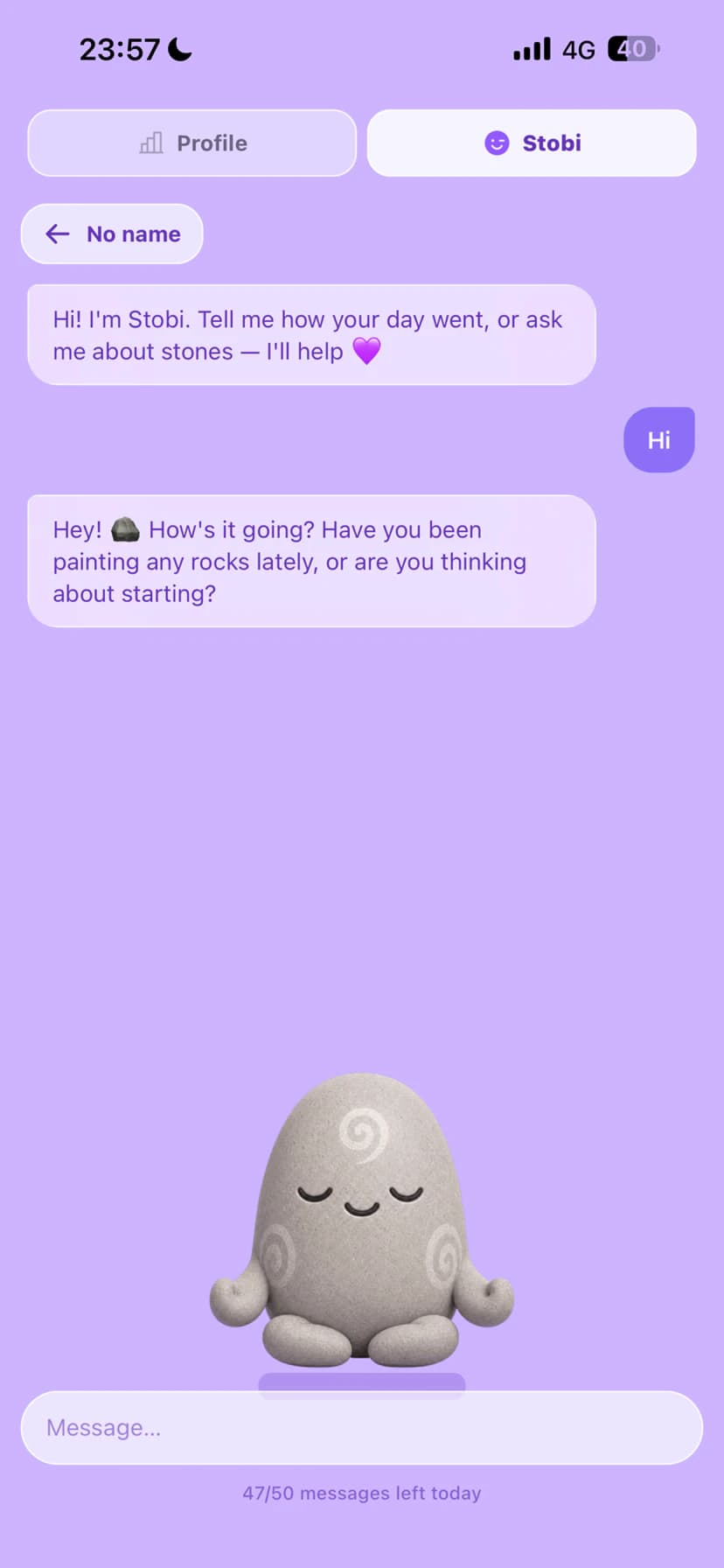
Companion
Guidance with personality
Stobi stays present beyond the scanner through customization, prompts, and an optional conversational layer.

First impression
A recognizable entrance
The splash screen introduces the character and the lavender product world before the first task begins.
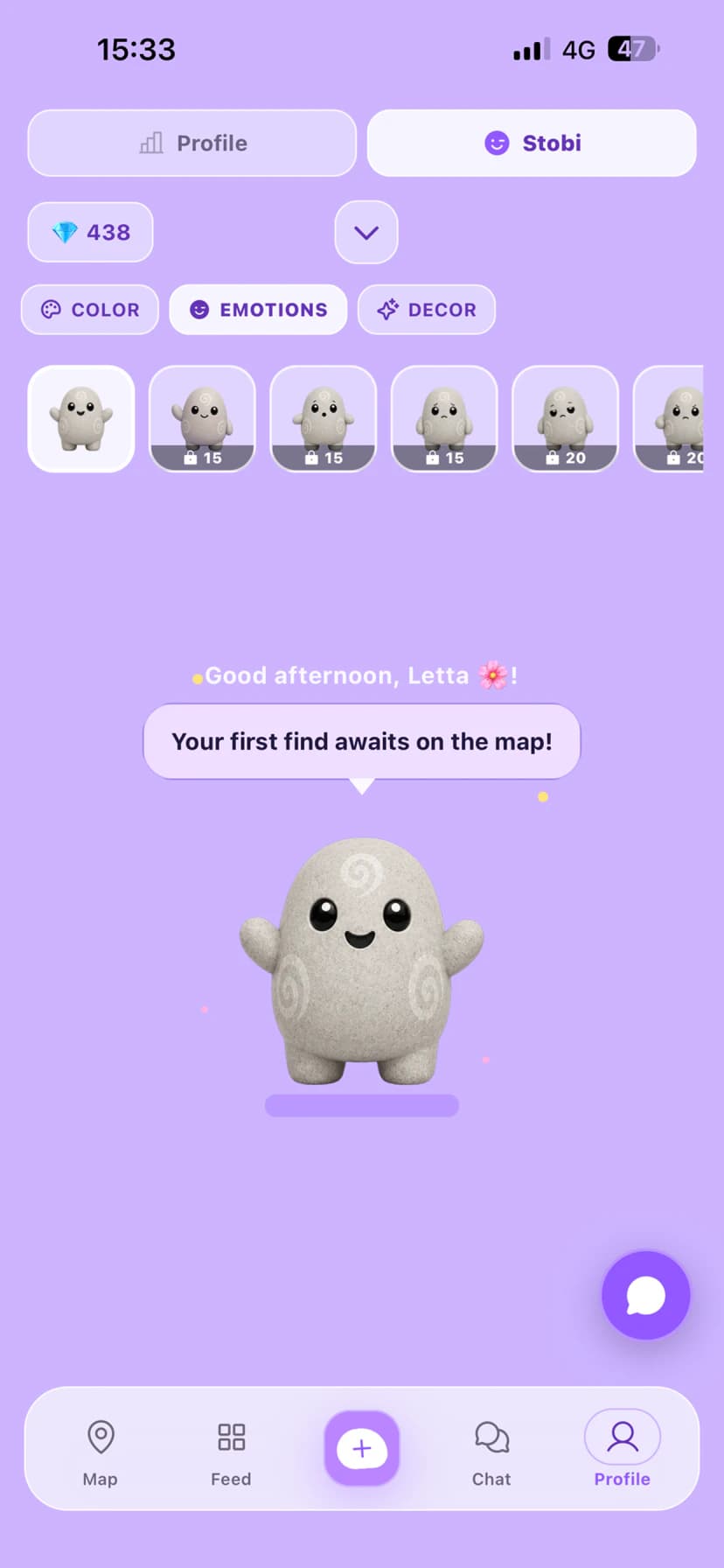
Personalization
A reason to return
Custom expressions, color, and decor give the companion a lightweight progression loop around the core hunt.
Planned tests · not results
Test trust before testing delight.
The next validation pass focuses on the moments where users must understand, trust, or correct the system. These are planned tests, not completed results; real sessions and evidence will replace this draft as the mobile product moves toward release.
Does the first find drive engagement?
What does someone actually do before they come back?
- Method
- Reading the launch data — installs, stones on the map, finds, and return visits.
- Success signal
- The people who kept using the app had found stones first: engagement turns on the first find, not the install. That now sets the roadmap.
Scanner comprehension
Can a first-time user frame a painted surface and recover from an unclear scan without extra explanation?
- Method
- Task-based prototype test
- Success signal
- The user completes the scan and understands the rescan guidance independently.
AI match trust
Does the user understand why Stobi suggests an existing identity — and how to correct a wrong match?
- Method
- Moderated comparison task
- Success signal
- The user can choose same or different stone with a clear sense of control.
Guest-to-account gate
Can a guest reach the product value before sign-up and continue the same stone journey after authentication?
- Method
- End-to-end usability task
- Success signal
- Registration does not erase the scan result or interrupt the user's mental model.
Journey clarity
Can the user identify the artist, latest finder, previous locations, and the next action from one record?
- Method
- Comprehension check
- Success signal
- The user can explain the stone's story and what happens after re-hiding it.
Work that moved the product forward.
Defined the AI-scanner experience that detects whether a stone is painted.
Designed the matching logic that decides whether a scan belongs to the same stone or a different one.
Designed the information model connecting one stone to its artist, hiders, finders, photos, locations, and full history.
Created the Stobi brand identity, app icon, and character system with reusable emotions and poses.
Vibecoded the frontend and part of the backend, after the concept, research, product logic, UX and branding.
Read the launch data myself and let it set priorities: the people who kept using the app had found stones first, so engagement turns on the first find, not the install.
- Year
- 2026
- Contribution
- Product + UX/UI + Brand + Character + Frontend + Backend
- Industry
- Consumer app
Website live · iOS & Android apps released